News publication: May 2026
Inside Thriving in Motion: 15 years of therapeutic exercise for children who fall outside mainstream sport
A collaborative publication from Thriving in Motion and MHEX Research Group in British Journal of Sports Medicine. Senior authors, and co-founders of Thriving in Motion, A/Prof Bonnie Furzer and A/Prof Kemi Wright. Published May 2026.
Most children who struggle to engage in community sport don’t get a tailored alternative. They get a clinical referral, a waitlist, or nothing at all. A new service spotlight published in the British Journal of Sports Medicine documents what Thriving in Motion, a community-based program in Western Australia has built across 15 years to address that gap.
This post is for exercise physiologists, exercise scientists, paediatric allied health clinicians, and program designers working at the intersection of therapeutic exercise for children, mental health, and developmental support. The paper itself is open access at BJSM and the full citation is at the bottom of this article.
Why this matters
Australian and international evidence consistently identifies the same gap: regular physical activity is essential for child health and wellbeing, yet community sport and school-based activity is designed around a typical participant profile that excludes a substantial portion of children.
Kids with neurodivergence, complex health conditions, developmental coordination differences, mental health challenges, sensory considerations, or emotional and behavioural complexity are routinely under-served. They are also the kids for whom physical activity matters most in the long run.
Where alternatives exist, they often sit inside a medical model: clinical, expensive, time-limited, and disconnected from the social fabric of typical childhood activity. Families navigating multiple appointments and limited support funding do not always have the resources to add another clinical session to the calendar, and many kids coping with school during the week are not going to find joy in a clinic-feeling exercise hour on a Saturday morning.
This is the gap that Thriving in Motion’s Kids & Teens program was built for. Founded in 2011 and now documented in a service spotlight in BJSM, the program has reached 4000+ enrolments over 15 years, operating across multiple metropolitan locations in WA on a fee-supported model that minimises the burden on families to navigate individual funding access. https://www.thrivinginmotion.org/exercise-programs/thriving-kids-and-teens/
Inside the model
Three commitments anchor the program:
- Accessible evidence-based exercise expertise: Sessions are delivered by tertiary-educated Exercise Scientists, Exercise Physiologists, and aligned allied health providers. The credentialling matters because it lets the service handle the complexity of the population without compromising on safety or programming quality. The program is fee-supported through grants and philanthropy, primarily via Channel 7 Telethon Trust and in-kind support from the University of Western Australia, which removes the burden of individual funding navigation for families.
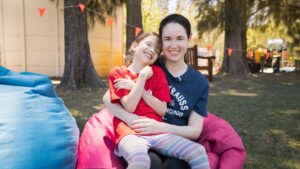
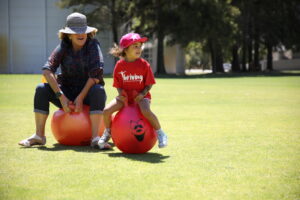
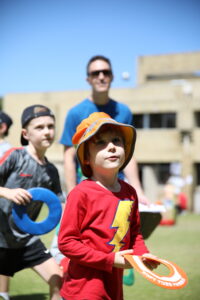
- Strengths-focused, inclusive, flexible, and fun: Program structures flex between 1:1 sessions (currently 64% of delivery), small group sessions (34%), and school holiday programs. Instructor-to-participant ratios are adjusted based on need. Activity selection responds to the individual child’s interests rather than a fixed curriculum or age based groups. The point is to look more like childhood and less like a clinic, but create a space where every child has the opportunity to experience success.
- Centering the young person and their family: Co-design principles are embedded across the program through Parent Advisory Group and Youth Advisory Group input, formal end-of-year surveys, and informal feedback channels between instructors and families. Sessions are designed with equal weight given to youth-centred care and to the latest evidence in each child’s presenting condition, with robust evidence generation part of the model through our research partners (www.thrivinginmotion.org/mhex and University of Western Australia).
What 15 years of data show
The paper presents a substantial intake and outcomes dataset, with a few patterns worth noting .
The population is high-complexity – at intake (n=277), 80% of children have one or more medical diagnosis.
- 61% are neurodivergent, including Autism and ADHD.
- 18% have intellectual, learning, or communication impairments.
- 15% have mental health diagnoses including conduct disorder, anxiety, OCD, depression, and gender or body dysphoria.
- 14% have muscle or bone conditions including cerebral palsy, chronic pain, arthritis, and hypermobility.
- 9% have motor or movement impairments including DCD.
Functional intake patterns are consistent:
- 83% are seeing another health professional or assistive service.
- 77% experience difficulties socialising.
- 61% experience situations that cause anxiety.
- 59% have behavioural challenges that require consideration in programming.
- 59% require assistance at school.
On standardised measures, the picture is stark. On the Child Behaviour Checklist Syndrome Scales (n=53), 77% have at least one scale at clinical or borderline level, with 55% in the clinical or borderline range for internalising problems and 55% for attention problems. This is not a general community fitness population. It is a population that mainstream sport does not serve well and that standard clinical services often cannot serve affordably.
Retention and quality of care is a key takeaway, with family feedback indicating:
- 38% of families had been engaged for more than two years, and a further 31% for between 12 months and 2 years.
- 96% would recommend the service to other families.
- 97% felt instructors were approachable and welcomed discussion.
- 78% felt instructors were knowledgeable and able to answer questions.
For practitioners familiar with paediatric attrition in mainstream sport, these retention numbers are the headline finding. Programs serving high-complexity populations typically see significant drop-off. Sustained engagement of this kind suggests the model is doing something the alternatives are not. [Wright et al 2023 Thriving Families]
The M.A.G.I.C framework
The most portable contribution of the paper is the M.A.G.I.C framework that operationalises the programme’s approach to physical literacy. Co-designed with families and grounded in self-determination theory and self-efficacy theory, M.A.G.I.C is a five-element shared language for what supports lifelong engagement in physical activity for this population.
M for Motivation: focus on activities the child genuinely enjoys, rather than fitness or function targets imposed externally.
A for Autonomy: give the child meaningful choice in their activity, and explain the reasoning behind program design rather than presenting it as a directive.
G for Grit: explicitly recognise and address the challenges that neurodivergent children and children with emotional or behavioural difficulties face in persisting through setback. This is the element specifically developed for the population and the one that distinguishes M.A.G.I.C from generic physical literacy work.
I for Interconnected: build social connection with friends, family, and instructors as part of the activity rather than as a side effect.
C for Confidence: deliberately design supportive, positive environments rather than competitive or pressured ones.
The framework is used in both parent training and instructor training, which means it functions as a programming logic and a workforce development tool at the same time. For services trying to operationalise Self-Determination Theory in paediatric exercise contexts, M.A.G.I.C is a usable, named, theory-grounded scaffold.
What this means for practice
A few practical takeaways for clinicians and program designers.
- If your service is structured around 1:1 clinical exercise sessions, look at where small-group or flexible-ratio formats could open additional value, particularly for children whose social goals are part of what they need from exercise. Consider remove ‘age grouping’ and instead focus on needs and presentation.
- If you are developing instructor or workforce training in paediatric exercise, M.A.G.I.C offers a portable named framework that translates psychological theory into delivery practice.
- If you are commissioning or designing services for under-served paediatric populations, the Thriving model points to two structural choices worth replicating: removing individual funding navigation (fee-supported through grants and philanthropy) and embedding co-design through ongoing advisory groups rather than one-off consultation.
- If you are an exercise physiologist working with neurodivergent children, the explicit Grit component is worth pulling into your own work even outside the full program structure.
- If you are a researcher, the living-lab approach is worth studying as a translation model. Research arms sit inside service delivery rather than parallel to it, which shortens the feedback loop between practice and evidence.
The honest limits
The paper is clear about the conditions that make this model viable. Thriving in Motion operates in a high-SES country (Australia), with access to philanthropic funding through annual grant cycles and in-kind support from local community facilities. Replicating the model in lower-resourced settings will require local adaptation, including different funding pathways and different community partnership structures.
However, the underlying principles (M.A.G.I.C, co-design, accessible evidence-based delivery) could be implemented outside of this funding model.
The details
Citation: Furzer, B., Austin, F., Kramer, B., Almarjawi, A., Edwards, G., Hilston, J., Quick, B., Davies, M., & Wright, K. (2026). Thriving in Motion: a community-based therapeutic physical literacy programme for children experiencing barriers to being active. British Journal of Sports Medicine. https://bjsm.bmj.com/content/early/2026/05/12/bjsports-2026-111761
Service website: https://www.thrivinginmotion.org/
Research website: https://www.thrivinginmotion.org/mhex
Funding: Channel 7 Telethon Trust (partial programme funding); in-kind support from the University of Western Australia.
Talk to us
If you are working in paediatric exercise, allied health, or community-based youth physical activity and would like to connect with Thriving in Motion to discuss the model or potential collaboration, get in touch via the contact link on this site, follow MHEX and Thriving in Motion on Instagram and LinkedIn (@thrivinginmotionorg / @MHEXresearch).