Community research, led by the clinicians who run our programs, and built back into them.
Most community exercise programs for children are not evaluated, and almost none are described in the peer-reviewed literature. Ours is. The paper sets out how the Thriving model works, who it is built for, and what more than a decade of community delivery has achieved for children who experience barriers to being active.
Furzer, B., Austin, F., Kramer, B., Almarjawi, A., Edwards, G., Hilston, J., Quick, B., Davies, M., & Wright, K. (2026). Thriving in Motion: a community-based therapeutic physical literacy program for children experiencing barriers to being active. British Journal of Sports Medicine.
Read the paperResearch at Thriving is not a separate activity from what we deliver, it is where the programs come from and how they are adapted and improved over time. Our research is led by the clinicians who deliver our programs, done in the community, and built straight back into what families receive. Two of our completed studies now sit inside the services families use every week.
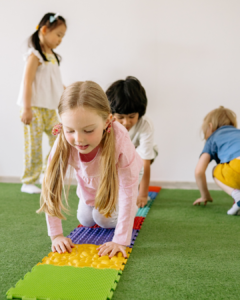
Physical literacy is the motivation, confidence, competence and understanding that allows a person to stay active across a lifetime. Four out of five Australian children do not meet physical activity guidelines, and the children least likely to meet them are those with physical, developmental or behavioural barriers to participation.
Thriving Families asked whether physical literacy could be built deliberately, by training parents and instructors as coaches rather than treating exercise as something done to a child. It could. The study produced the MAGIC framework, which now shapes how every one of our children’s programs is designed, and which we give to families free.
The full model, and what it has achieved across more than a decade of community delivery, is set out in the British Journal of Sports Medicine paper above.
Substance use disorders affect around one in eight young Australians. Young people in residential treatment carry a high risk of long-term physical health problems, and the inactivity that comes with treatment makes that worse. Exercise has clear benefits in adult treatment settings, but youth services in Western Australia and nationally are badly under-serviced.
Delivered with the UWA Exercise and Performance Centre, DAYS tested structured exercise inside youth treatment for substance use, looking at physical and mental health, engagement with rehabilitation goals, and how young people came to see exercise itself. What mattered most was enjoyment. Young people who enjoyed the exercise were more confident about staying in recovery, which is not a finding you can design a program around by accident.
It now runs as a service rather than a study.
Three national studies are running now, both with our evaluation partners Mental Health + Exercise Research Group, at The University of Western Australia and University of New South Wales.
Central auditory processing disorder affects between three and seven per cent of school-aged children. These children can hear, but they struggle to make sense of what they hear, which shows up as difficulty in the classroom, in friendships and in confidence. Effective treatments are scarce, and the difficulties often persist into adulthood.
SPaCE brings together audiology, neuroscience and exercise physiology to test whether rhythmic exercise paired with music can improve both auditory processing and mental health in these children. Pilot phase of the study is now complete, and full trials are due to roll out in children and adults early 2027.
More than 200,000 Australian university students are estimated to experience mental health problems each year, and universities have not yet built exercise into how they treat them. Exercise improves symptoms, and a well-designed program also builds the peer support that students are often missing.
Stride launched at UWA in 2020 as a supervised, referral-based, peer-led twelve week exercise program for students experiencing mental health difficulties, free to participants and the first of its kind in Australia. It is now running and being evaluated at UNSW as well.
Trans and gender diverse young people are less active than their peers, feel less safe in sport, and face more barriers to taking part. A scoping review led by our team found that every study examining those barriers connected exclusion in sport and school physical education to mental health harm.
Dr Felicity Austin’s PhD asked what an exercise program would need to look like for it to actually work for these young people, and built one inside a specialist paediatric gender diversity service. The program is now being delivered and evaluated nationally as part of the ARCTYC collaboration.
Our team publishes in peer-reviewed journals across physical literacy, youth mental health and inclusive practice. A selection is below.
Furzer, B., Austin, F., Kramer, B., Almarjawi, A., Edwards, G., Hilston, J., Quick, B., Davies, M., & Wright, K. (2026). Thriving in Motion: a community-based therapeutic physical literacy programme for children experiencing barriers to being active. British Journal of Sports Medicine. Advance online publication. doi.org/10.1136/bjsports-2026-111761
Wright, K. E., Jackson, B., Licari, M. K., Dimmock, J. A., & Furzer, B. J. (2023). Thriving families: The feasibility and preliminary efficacy of a multi-component physical literacy program for children with neurodevelopmental, emotional, or behavioural problems. Mental Health and Physical Activity, 25, 100558. doi.org/10.1016/j.mhpa.2023.100558
Almarjawi, A. C., Wright, K. E., Buist, B. D., Cairney, J., Ton, T. T., & Furzer, B. J. (2023). Reliability of fitness assessments in children with emotional and behavioral difficulties. Pediatric Exercise Science, 1–8. doi.org/10.1123/pes.2022-0058
Wright, K. E., Furzer, B. J., Licari, M. K., Dimmock, J. A., Jackson, B., & Thornton, A. L. (2020). Exploring associations between neuromuscular performance, hypermobility, and children’s motor competence. Journal of Science and Medicine in Sport. doi.org/10.1016/j.jsams.2020.06.007
Wright, K. E., Furzer, B. J., Licari, M. K., Thornton, A. L., Dimmock, J. A., Naylor, L. H., Reid, S. L., Kwan, S. R., & Jackson, B. (2018). Physiological characteristics, self-perceptions, and parental support of physical activity in children with, or at risk of, developmental coordination disorder. Research in Developmental Disabilities, 84, 66–74. doi.org/10.1016/j.ridd.2018.05.013
Kramer, B., Wright, K., Jackson, B., Simpson, A., & Furzer, B. (2026). Exercise as a novel treatment to improve engagement with mental health services in youth with clinical mental illness: Review and recommendations. Mental Health and Physical Activity, 31, 100801. doi.org/10.1016/j.mhpa.2026.100801
Jeftic, I., Jackson, B., Rebar, A., Furzer, B., Dimmock, J., Budden, T., Wright, K., Boyd, C., Rosenberg, M., Sabiston, C. M., deJonge, M., & Simpson, A. (in press). Exercise enjoyment and depressive symptoms for university students in a mental health service: An intensive repeated measures study. Journal of Applied Sport Psychology.
Jeftic, I., Furzer, B., Dimmock, J., Wright, K., Budden, T., Boyd, C., Simpson, A., Rosenberg, M., Sabiston, C., de Jonge, M., & Jackson, B. (2023). The Stride program: Feasibility and pre-to-post program change of an exercise service for university students experiencing mental distress. Psychology of Sport & Exercise, 69, 102507. doi.org/10.1016/j.psychsport.2023.102507
Wright, K., Rosenbaum, S., & Furzer, B. (2022). Mental health and illness. In A. Scott & D. Broom (Eds.), Exercise Management for Referred Medical Conditions (Ch. 20). Routledge. doi.org/10.4324/9781315102399-20
Furzer, B., Rebar, A., Dimmock, J. A., More, A., Thornton, A. L., Wright, K., Colthart, A., & Jackson, B. (2021). Exercise is medicine… when you enjoy it: Exercise enjoyment, relapse prevention efficacy, and health outcomes for youth within a drug and alcohol treatment service. Psychology of Sport and Exercise, 52, 101800. doi.org/10.1016/j.psychsport.2020.101800
More, A., Jackson, B., Dimmock, J. A., Thornton, A. L., Colthart, A., & Furzer, B. J. (2017). Exercise in the treatment of youth substance use disorders: Review and recommendations. Frontiers in Psychology, 8, 1839. doi.org/10.3389/fpsyg.2017.01839
Austin, F., Lin, A., Wright, K., Jackson, B., Simpson, A., & Furzer, B. (2026). Exercise experiences of adolescents engaged with gender diversity services: A qualitative approach. Psychology of Sport & Exercise, 85, 103148. Advance online publication. doi.org/10.1016/j.psychsport.2026.103148
Austin, F., Wright, K., Jackson, B., Lin, A., Schweizer, K., & Furzer, B. (2024). A scoping review of trans and gender diverse children and adolescents’ experiences of physical activity, sport, and exercise participation. Mental Health and Physical Activity, 26, 100576. doi.org/10.1016/j.mhpa.2024.100576
Almarjawi, A., Furzer, B., Mulders, W., Edwards, G., Tarawneh, H., Linton, N., Austin, F., Wright, K., Jackson, B., Brennan-Jones, C., & Choi, R. (2026). Auditory-Cued Exercise Therapy (ACET) in 7 to 12 year old children with listening difficulties: A feasibility and pilot trial protocol. Speech, Language and Hearing, 29(1). doi.org/10.1080/2050571X.2026.2652120
This is a selection. The full and current publication list for our team is maintained on Google Scholar.
Full publication list on Google ScholarOur researchers lead a wider portfolio of work through the Mental Health and Exercise (MHEX) group at the University of Western Australia. Recruitment for current studies, and enquiries about collaboration, are coordinated there.
Visit MHEX · LinkedIn · Instagram
For anyone following the work Plain language write-ups of what we are finding and why it matters. MHEX resources
For families Short videos on building confidence, motivation and movement at home, free to watch. Thriving in Motion on YouTube
Co-founder and CEO / Senior Exercise Physiologist
Bonnie has spent fifteen years building exercise programs for children the mainstream system was not designed for, and researching whether they work. She holds an academic position at the University of Western Australia and led the British Journal of Sports Medicine paper describing the Thriving model.
Co-founder and COO / Senior Exercise Physiologist
Kemi's research into how children with neurodevelopmental, emotional and behavioural differences build the motivation and confidence to be active produced the MAGIC framework, which now sits underneath every program we run and every family resource we publish.
They are not the whole story, with our Thriving Team named authors on the work above, several are completing higher degrees alongside their clinical caseloads, and our research runs through the Mental Health and Exercise group at the University of Western Australia. A community organisation of our size holding a research workforce is unusual, and it is the reason our programs change when the evidence does.
Meet the team