

Youth Moves wins the UWA School of Human Sciences Award for Innovation and Impact
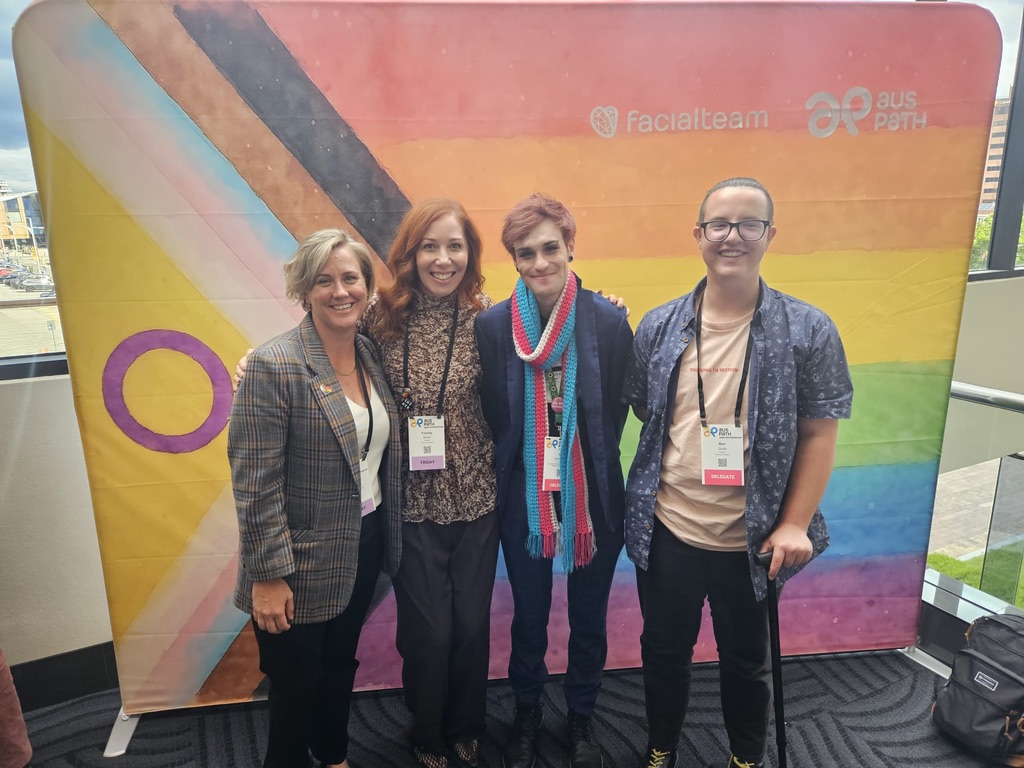
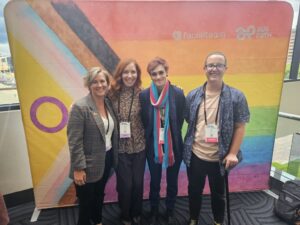
Bonnie Furzer, Felicity Austin, Ben Kramer and Kai Schweizer representing the Youth Moves research team at a conference.
Youth Moves, the gender-affirming exercise program for trans and gender diverse young people led by Felicity Austin, has been recognised with the University of Western Australia's School of Human Sciences Award for Innovation and Impact. It is a fitting marker for a program that started as a single scoping review and has grown into a national model now shaping policy, funding and practice across Australia.
Youth Moves is the first trans-specific, group-based movement program embedded within a paediatric gender diversity service in Australia, delivered through the Perth Children's Hospital CAHS Gender Diversity Service and community health settings for young people aged 12 to 24. Mainstream fitness and sport environments have long excluded trans and gender diverse young people, and until recently there was no evidence-based exercise intervention built specifically for this group.
Built on evidence, not assumption
What sets Youth Moves apart is how deliberately it was built. The program sits on a peer-reviewed scoping review that first established the evidence gap (Austin et al., 2024), a qualitative study capturing adolescent, family and clinician perspectives (Austin et al., 2026), and a published, ethics-approved trial protocol (Austin et al., 2025). It was then tested using a Type 2 hybrid effectiveness-implementation design, one of the first applications of this methodology to a gender-affirming intervention anywhere in the world.
The completed pilot trial (ACTRN12625000351415, n=20) recorded no adverse events, 95% engagement and retention, and its largest effect was a moderate improvement in mental health, measured on the SF-12 Mental Health Component (d=0.48). For a voluntary program working with a group that mainstream services routinely fail to reach, those numbers speak for themselves.
Stay connected with MHEX
Research updates, clinical tools, and news from the Mental Health and Exercise Research Group. Sent every 6(ish) weeks.
“I thought the program would be a good way to exercise, where my gender wouldn’t be an issue, that doesn’t happen often.”
Youth Moves participant
From a single site to a national program
Youth Moves has scaled from that first trial into a national program now expanding into South Australia, New South Wales and Victoria, through the MRFF-funded ARCTYC consortium, worth around $4.9 million, a direct government endorsement of the program's evidence base. The WA Department of Communities and LGBTQIA+ Health Australia have committed further service-delivery funding on the strength of these outcomes.
The team has also built Youth Moves Connect, a co-designed digital delivery model closing the access gap for trans young people in rural and remote Australia, believed to be the first model of its kind internationally. For community, the program has created lived-experience employment pathways, including Consumer Lead and Peer Facilitator roles, alongside the wellbeing and connection outcomes the trial recorded.
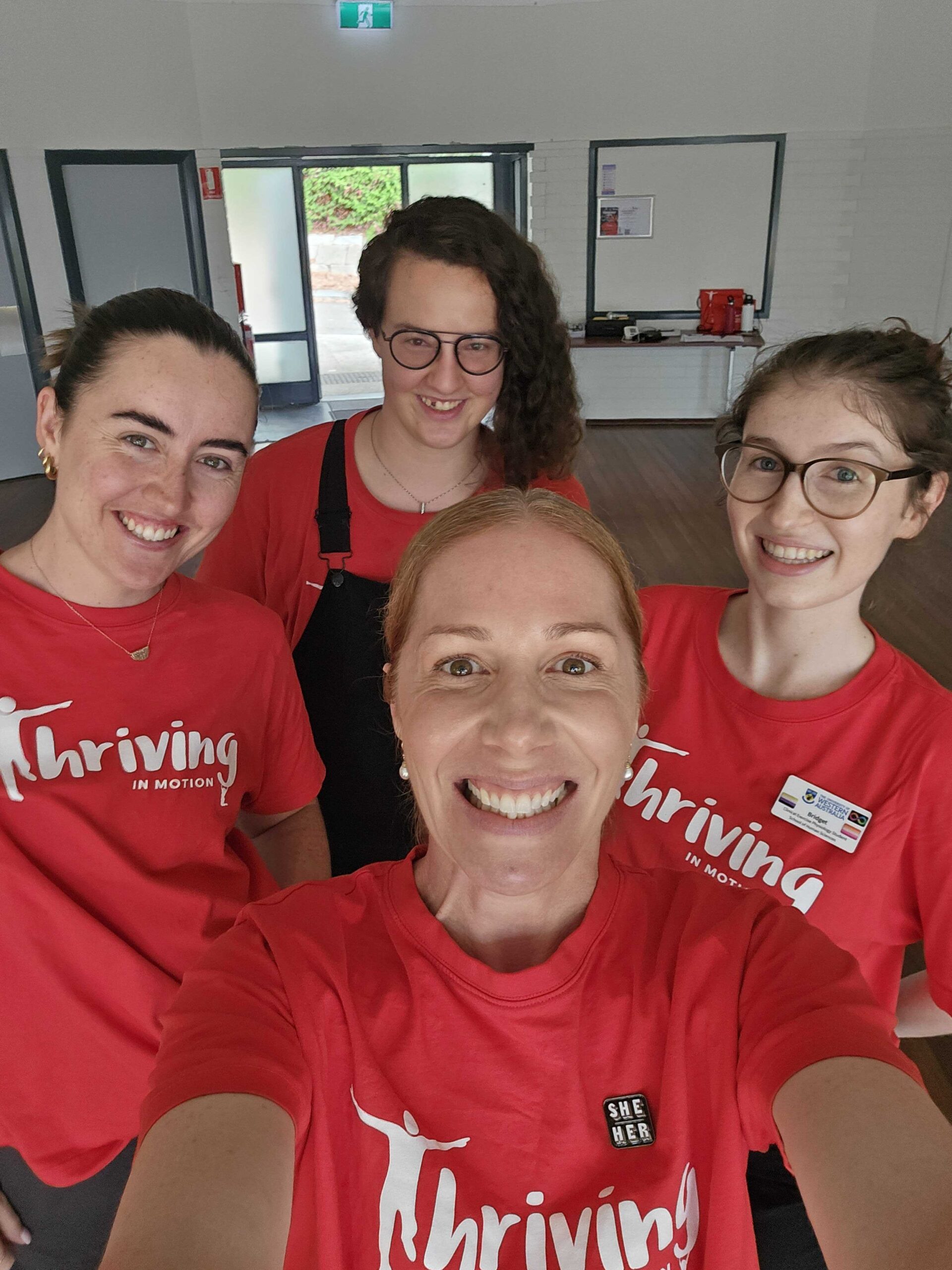
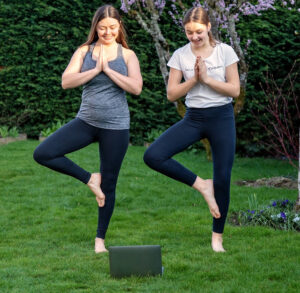
The Youth Moves clinical team, Felicity Austin, Ben Kramer, Kayleen and Bridget, ready to start a session.
Building the sector, not just the program
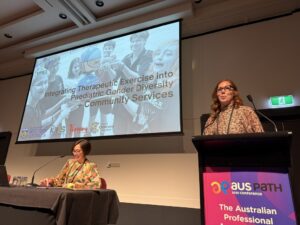
Youth Moves has trained more than 110 exercise physiology students in inclusive movement practice, generated four peer-reviewed publications, and reshaped clinical guidance through presentations at seven national conferences, including AusPATH, ESSA, the Asia-Pacific Society for Physical Activity, the Youth Affairs Council WA and the Society for Mental Health Research. The program has now been recognised through four sector awards, including the 2024 AUSactive National Most Inclusive and Diverse Program Award, alongside this latest recognition from UWA.
Congratulations to Felicity Austin and the whole Youth Moves team on this recognition, and on everything the program has built to earn it.
If you or someone you know needs support around gender identity, QLife is on 1800 184 527.
The MHEX (Mental Health and Exercise Research Group) team, co-led by Associate Professor Bonnie Furzer (UWA) and Associate Professor Kemi Wright (UNSW), works across research, clinical practice and community delivery to build the evidence for exercise in mental health care.
The evidence behind Youth Moves
Austin, F., Wright, K., Lin, A., Jackson, B., Moore, J., Saunders, L., Laming, B., Munsie, C., Kramer, B., Quick, B., Almarjawi, A., Simpson, A., & Furzer, B. (2026). A therapeutic exercise program for trans and gender diverse young people: an effectiveness-implementation pilot trial. Health Education and Behavior. Read the pilot trial.
Austin, F., Lin, A., Wright, K., Jackson, B., Simpson, A. & Furzer, B. (2026). Exercise experiences of adolescents engaged with gender diversity services: a qualitative approach. Psychology of Sport and Exercise.
Austin, F., Lin, A., Wright, K., Jackson, B., Moore, J. K., Saunders, L., Ferguson, G., Skeldon, S., Simpson, A. & Furzer, B. (2025). A therapeutic exercise program for adolescents engaged in gender diversity services: study protocol for a non-randomised clinical trial. Translational Exercise Biomedicine (advance online).
Austin, F., Wright, K., Jackson, B., Lin, A., Schweizer, K. & Furzer, B. (2024). A scoping review of trans and gender diverse children and adolescents’ experiences of physical activity, sport, and exercise participation. Mental Health and Physical Activity, 26, 100576.
Stay connected with MHEX
Research updates, clinical tools, and news from the Mental Health and Exercise Research Group. Sent every 6(ish) weeks.