In collaboration with


What should we measure when exercise is part of eating disorder treatment?
Exercise therapy in eating disorders has come a long way from the days when the only advice was to stop. More treatment teams now include an accredited exercise physiologist or another exercise professional. That raises a practical question with surprisingly little research behind it: once exercise is part of care, how does a team know whether it is helping, and whether it is safe?
A new scoping review in BJPsych Open takes that question on. It was led by Caleb McMahen (Charles Darwin University, The University of Western Australia and Fremantle Hospital and Health Service), with Ben Kramer (UWA, Fremantle Hospital and Health Service and Thriving in Motion), Kai Schweizer (UWA, The Kids Research Institute Australia and InsideOut Institute), and MHEX co-leads A/Prof Kemi Wright (UNSW Sydney and Thriving in Motion) and A/Prof Bonnie Furzer (UWA, Fremantle Hospital and Health Service, Thriving in Motion and The Kids Research Institute Australia). It is the first review to map the outcome measures used in exercise research with adults who have an eating disorder.
How the review was done
A scoping review maps what research exists rather than pooling results to estimate an effect. The team searched PsycINFO, Medline and EMBASE in 2023, then re-ran the searches in October 2024 and February 2026. They included 26 studies of adults aged 18 to 65 with a diagnosed eating disorder: 15 exercise intervention studies and 11 observational or cross-sectional studies. Half involved mixed diagnostic groups. Seven focused on anorexia nervosa, five on binge eating disorder and one on bulimia nervosa.
Body size is measured everywhere. Fitness rarely is.
Every one of the 26 studies measured body composition, and all of them reported body mass index (BMI). Eating disorder severity came next, in 21 studies, most often using the Eating Disorder Examination or the Eating Disorder Inventory. Thirteen studies asked people to self-report their physical activity.
Direct tests of physical capacity were much rarer. Only 11 studies included any exercise assessment: six tested strength, six tested cardiorespiratory fitness (how well the heart, lungs and muscles use oxygen during sustained activity) and five used the six-minute walk test. Quality of life was measured in five studies, and cardiometabolic markers such as blood tests or blood pressure were reported in three.
Weight and BMI are essential in eating disorder care, but how well BMI reflects overall health in this population is debated. The authors suggest strength and fitness testing could tell a treatment team things BMI cannot. Low cardiorespiratory fitness, for example, is a well-established predictor of mortality in general and chronic disease populations.
What changed with supervised exercise
Sixteen studies reported outcomes before and after an exercise program. As a scoping review, it summarised the direction of change rather than calculating effect sizes or rating study quality.
- All five studies that measured dysfunctional exercise (compulsive or driven exercise that harms physical or psychological health) found significant reductions after exercise therapy.
- In the nine studies tracking weight and BMI, change was in line with treatment goals every time, with no difference from control groups. Put simply, exercise did not work against weight restoration.
- Muscle strength improved significantly in all three studies that tested it, and four of five studies found significant gains in aerobic fitness compared with controls.
- Psychological symptoms generally improved, although only two studies found a difference between exercise and non-exercise groups.
No included study reported an adverse event. Adverse events are known to be under-reported in exercise trials and people with eating disorders can be medically vulnerable, so it is a signal of safety in supervised settings rather than a guarantee.
What changed after supervised exercise
Direction of change in selected outcomes across 16 pre and post intervention studies
Dysfunctional exercise
5 studies
Significant reduction in all five
Muscle strength and function
3 studies
Significant improvement in all three
Aerobic fitness
5 studies
Significant gains compared with controls in four of five
Quality of life
2 studies
Significant improvement compared with controls
Psychological symptoms
10 studies
Generally improved; two showed a difference from non-exercise groups
Weight and BMI
9 studies
Change in line with treatment goals; no difference from controls
Bone mineral density
3 studies
Mostly no change
Physical activity levels
2 studies
No significant change
Clear improvement Positive, with caveats Little or no change
What this could mean in practice
For services building exercise into eating disorder care, a few practical points stand out.
Assess the relationship with exercise, not only the amount. The Compulsive Exercise Test (CET) was the most used tool for dysfunctional exercise, appearing in six studies. Given its validation and sensitivity to change, the authors suggest it may be the most relevant tool for screening exercise beliefs and behaviours and tracking them over time.
Consider fitness testing, with care. Both maximal and submaximal strength and cardiorespiratory tests were used without reported harm. Treadmill protocols (Balke and Bruce) and one-repetition maximum testing of major lifts were most common, and grip strength offers a simpler option. Whether to test at all depends on medical stability and sits with the treatment team.
Think about how activity is tracked. Wearable devices give more accurate data than self-report, but real-time feedback on a device can reinforce rigid targets for some people. Practitioner-supported monitoring may avoid that.
Work within scope. Many eating disorder severity tools are diagnostic instruments. The authors note they are best administered by clinicians with specialist training, such as clinical psychologists or psychiatrists, and that exercise professionals need to consider their scope of practice, particularly where the wider team is limited.
Don’t read missing data as reassurance. Cardiometabolic measures were rarely reported, most likely because they were collected for medical screening rather than as study outcomes. That is not a reason to skip them.
What the review can’t tell us
The review covered adults only. Fifteen studies were excluded at full-text screening because they involved adolescents, so the findings may not translate directly to younger people. The evidence also leans heavily on mixed diagnostic groups and anorexia nervosa, with a single bulimia nervosa study. Without effect sizes, it also can’t say how much exercise therapy improves any outcome.
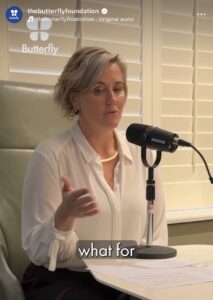
What it does offer is a map to help services choose assessments that are consistent, safe and clinically meaningful, and to make future studies easier to compare. For more on approaching movement in recovery, listen to Bonnie on Butterfly Foundation’s Let’s Talk podcast.
Read the paper
The paper is open access. McMahen C, Kramer B, Schweizer K, Wright K, Furzer B. Eating disorders and exercise therapy: scoping review on outcome measures used in eating disorder and exercise research. BJPsych Open. 2026;12(6):e275. doi:10.1192/bjo.2026.12135
Need support?
If you are concerned about an eating disorder for yourself or someone you care about, contact the Butterfly National Helpline on 1800 33 4673 (1800 ED HOPE) or visit butterfly.org.au. In an emergency, call 000.
About MHEX. The Mental Health and Exercise Research Group, co-led by Associate Professor Bonnie Furzer (UWA) and Associate Professor Kemi Wright (UNSW), works across research, clinical practice and community delivery to build the evidence for exercise in mental health care. More about Bonnie.
Stay connected with MHEX
Research updates, clinical tools, and news from the Mental Health and Exercise Research Group. Sent every 6(ish) weeks.
Thank you
You have joined the MHEX newsletter list.
More MHEX News




The MHEX Team acknowledges all Aboriginal and Torres Strait Islander Traditional Custodians of Country and recognises their continuing connection to land, sea, culture and community. We pay our respects to Elders past, and present.
We are committed to embracing diversity and eliminating all forms of discrimination through education and inclusive communities. We welcome all people and are respectful of individual identities.