Is exercise helping or harming eating disorder recovery? Bonnie Furzer on Butterfly’s Let’s Talk podcast
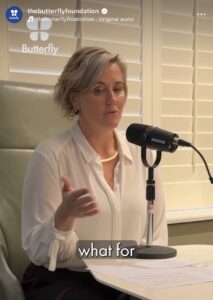
Straight after the ANZAED conference, MHEX co-lead Associate Professor Bonnie Furzer sat down with psychologist Dr Beth Shelton, host of Butterfly Foundation’s Let’s Talk podcast. The episode tackles a question that clinicians, families and people in recovery come back to again and again: is exercise helping or harming recovery from an eating disorder?
Bonnie is an Accredited Exercise Physiologist, Associate Professor at The University of Western Australia and exercise physiology program coordinator at Fremantle Hospital Mental Health Service. You can listen to the full conversation below.
Let’s Talk is a Butterfly Foundation podcast. Show notes and resources are on the Butterfly episode page.
Moving on from “just stop”
For a long time the default response in eating disorder care was to remove exercise altogether. The logic made some sense, as exercise can carry real medical risk when someone is physically compromised, and it can feed into the illness itself. Bonnie is clear that those risks need to be managed, but her point is that a blanket ban is not the same thing as a plan and is not what we are striving for in optimising patient-centered care.
“The blanket bans were never actually evidence-based. They left people unsupported, and the behaviour continues anyway.”
A/Prof Bonnie Furzer, Let’s Talk
Over the past couple of decades the field has shifted. Rather than trying to eliminate the symptom, the focus is moving toward understanding the relationship a person has with movement, and changing that relationship so supported movement contributes to their physical and mental health and to their recovery.
Stay connected with MHEX
Research updates, clinical tools, and news from the Mental Health and Exercise Research Group. Sent every 6(ish) weeks.
Thank you. You have joined the MHEX list.
When movement stops serving health
Maladaptive exercise can be a clinical feature of eating disorders, and Bonnie notes it is common. The markers she describes are less about the activity and more about what drives it: rigidity, a sense of compulsion, moving mainly to control weight or to compensate for eating, guilt when movement can’t happen, and carrying on despite pain, injury or illness.
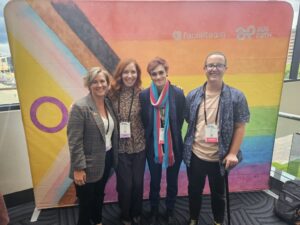
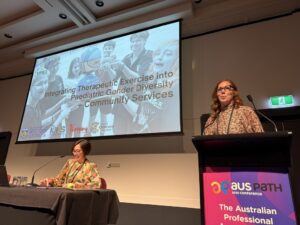
At the ANZAED workshop Bonnie and colleagues ran, delegates were asked for the first word that came to mind when they thought of movement in eating disorder care. Fear, stop and don’t came up. So did essential and a normal human experience, along with lack of funding. That mix captures where many teams sit: aware of the value, unsure what is safe, and not always sure how to start the conversation.
Ask why, not just what
Bonnie’s emphasised starting point is understanding what goal the movement is serving. Why are you doing this? What do you get from it? How do you feel afterwards? What happens if you stop? Knowing what someone does can be informative, but knowing why opens the door to a plan that keeps them safe without, in her words, pulling the rug out from underneath them.
Two examples from the episode make this concrete. If someone moves for social connection and identity, removing that takes away something that could be therapeutic. If movement is someone’s only way of regulating mood, the aim is not to strip it away but to work with the psychologist, OT or wider team so it is no longer the only tool they have.
Safety is a team job
Understanding the relationship with movement sits alongside managing physiological and medical risk, and that is where the multidisciplinary team comes in. GPs, medical teams, psychologists and psychiatrists feed the current safety picture through to the exercise professional, and the boundaries are communicated clearly to the person. Plans are made for good days and for harder ones, so a dip in medical or nutritional stability doesn’t leave everyone without a next step.
Bonnie points clinicians to the Safe Exercise at Every Stage (SEES) guidelines, which have recently been updated and include versions for adults, youth and athletes. They are freely available and step through medical, psychological and emotional indicators of risk, with recommendations for modifying movement at each stage. As people move further into recovery, the focus shifts toward reflection. Am I doing this because I feel I have to? Is it adding something positive to my day, or is it going to drain me? A walk done alone while counting minutes and the same walk outdoors with a friend can look identical on paper and feel completely different.
What this means for clinicians and carers
“Just stopping exercise is a disservice to patients, and it limits our ability to use this really accessible and helpful therapeutic modality.”
A/Prof Bonnie Furzer, Let’s Talk
For clinicians in multidisciplinary teams, the practical message is to ask people about their movement, and to find an exercise professional who is confident in this space and build them into the team. Many allied health professionals already have the language and strategies to explore someone’s relationship with movement. It is mostly a matter of making time for those questions.
For people in recovery and the people supporting them, Bonnie suggests reflecting on the reasons behind movement. If it looks rigid or seems to be taking away from health rather than adding to it, raise it with the treatment team. Butterfly Foundation and InsideOut Institute both have useful resources, including Butterfly’s guide to developing a positive relationship with exercise.
Bonnie also mentioned the national position statement on exercise and eating disorders that she and A/Prof Kemi Wright have led with a multidisciplinary team of exercise and eating disorder professionals. It brings together recent evidence and lived experience for exercise professionals and other health practitioners. Since the episode was recorded, it has been endorsed by Exercise and Sports Science Australia and is now in review for publication. We will share it here and in the newsletter once it is published.
Need support?
If you are concerned about an eating disorder for yourself or someone you care about, contact the Butterfly National Helpline on 1800 33 4673 (1800 ED HOPE), or chat online at butterfly.org.au.
Let’s Talk is produced for Butterfly Foundation and hosted by Dr Beth Shelton. Thank you to Beth and the Butterfly team for the conversation.
About MHEX. The Mental Health and Exercise Research Group, co-led by Associate Professor Bonnie Furzer (UWA) and Associate Professor Kemi Wright (UNSW), works across research, clinical practice and community delivery to build the evidence for exercise in mental health care. More about Bonnie.
Stay connected with MHEX
Research updates, clinical tools, and news from the Mental Health and Exercise Research Group. Sent every 6(ish) weeks.
Thank you. You have joined the MHEX list.