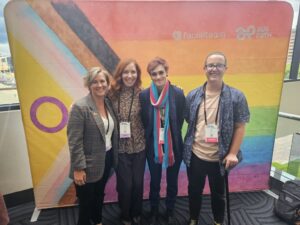
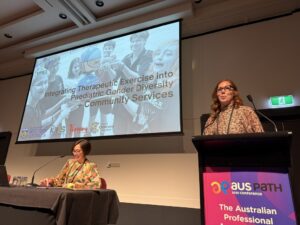
ESSA Activate is Australia’s premier conference for exercise and sports science, run by Exercise and Sports Science Australia (ESSA). It brings together researchers, clinicians, and exercise professionals from across Australia and internationally to share evidence, debate practice, and shape the direction of the field. The 2026 conference in Adelaide drew around 1,000 delegates and featured keynote speakers, interactive sessions, hands-on demonstrations, and the annual ESSA Awards night.
For MHEX, Activate is a key venue for sharing research with the practitioners and policymakers best placed to translate it into real-world care.
Poster 1: Chest Binding and Maximal Exercise Performance
Full title: Chest binding and maximal exercise performance: a randomised counterbalanced crossover trial
Authors: Claire Munsie, Brett Buist, Ben Kramer, Kai Schweizer, Grant Landers, Felicity Austin, Ashley Almarjawi, Ben Quick, Kemi Wright and Bonnie Furzer.
Affiliations: University of Western Australia, The Kids Research Institute, Curtin University, Thriving in Motion, University of New South Wales.
This poster presents a randomised counterbalanced crossover trial extending the preliminary findings shared earlier in 2026. The study examined whether wearing a chest binder during exercise affects aerobic fitness (VO₂max), upper body muscle strength (bench press and lat pulldown), lung function, shoulder range of motion, and perceptual responses to exertion.
Twenty-one binder-naive participants completed two sessions each (one in a binder, one without) in a randomised counterbalanced order. No significant differences were found across any outcome, and all effect sizes were small (Cohen’s d < 0.3). The findings challenge precautionary guidance that has historically discouraged binding during exercise, and support a reduction in this barrier to physical activity for trans and gender diverse people.
Download Poster 1
Poster 2: Fitness Testing in an Inpatient Mental Health Service
Full title: The feasibility and reliability of physical fitness tests within an inpatient mental health service
Authors: Andrew Lester, Conor Boyd, Ben Kramer, Kemi Wright, Ashley Almarjawi, Caleb McMahen, Ashlee Fraser-Dabell, Jessica Keye, Jacqueline Wu and Bonnie Furzer.
Affiliations: Fremantle Hospital Mental Health Service, University of Western Australia, Thriving in Motion, University of New South Wales.
Despite evidence linking low physical fitness to poorer health outcomes in people with severe mental illness, there is limited research on what physical assessment looks like in practice within acute inpatient settings. This study evaluated the feasibility and reliability of a standardised physical assessment battery, including isometric grip strength and a submaximal cardiorespiratory fitness (CRF) cycling test, in an adult inpatient mental health service.
Of 93 inpatients approached, 69% chose to voluntarily participate. Grip strength testing was highly feasible and showed good to excellent reliability (ICC = 0.88–0.92). The submaximal CRF test showed good reliability (ICC = 0.80–0.85) but lower completion rates, with protocol completion to target heart rate ranging from 33–45%. No adverse events were recorded. The findings support integrating standardised physical assessment into routine inpatient care, and point to the value of exploring lower-intensity aerobic protocols to improve completion rates.
Download Poster 2
Poster 3: Exercise as a Treatment to Improve Engagement with Mental Health Services in Youth
Full title: Exercise as a treatment to improve engagement with mental health services in youth with clinical mental illness: review and recommendations
Authors: Ben Kramer, Kemi Wright, Aaron Simpson, Ben Jackson and Bonnie Furzer.
Affiliations: University of Western Australia, The Kids Research Institute, Fremantle Hospital Mental Health Service, Thriving in Motion, University of New South Wales.
This review examines the role of structured exercise as an adjunctive treatment for young people with clinical mental illness who are transitioning from child and adolescent mental health services (CAMHS) to adult services, a period associated with high rates of disengagement, poorer outcomes, and increased risk of hospitalisation.
The synthesis draws on literature across exercise science, youth mental health, and recovery-oriented care. It identifies a strong conceptual alignment between exercise and recovery-oriented principles, including behavioural activation, improved self-efficacy, symptom management, and social connectedness. The authors argue that structured exercise is a feasible, scalable, and youth-appropriate adjunctive intervention that warrants further empirical attention within transitional care pathways.
Download Poster 3 (PDF)
Stay Connected
MHEX is a research group based at the University of Western Australia and University of New South Wales, focused on exercise in the treatment and management of mental health. To follow our work or get in touch, visit www.thrivinginmotion.org/mhex or mhex@uwa.edu.au