In collaboration with


A gender-affirming exercise program for trans and gender diverse young people: what a new pilot found
Trans and gender diverse young people are among the least active in the community, and not necessarily by choice. Reviews consistently show that trans young people take part in far less physical activity than cisgender peers, shaped by exclusion, the binary structure of most sport, and a lack of psychological safety in gyms and school PE. At the same time, this group carries a heavier load of mental and physical health challenges. The question, then, is not whether movement could help. It is whether a program can be built that trans young people feel safe enough to walk into, and keep coming back to.
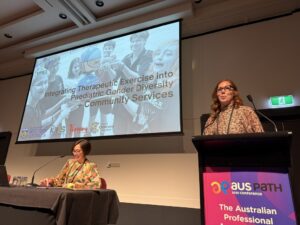
A new pilot trial, published in Health Education and Behavior, set out to test exactly that. Led by Felicity Austin (The University of Western Australia and Thriving in Motion) with Associate Professor Kemi Wright (UNSW), Associate Professor Bonnie Furzer (UWA and Thriving in Motion), and colleagues across Perth Children’s Hospital Gender Diversity Service, Telethon Kids Institute and Thriving in Motion, the study evaluated a 12-week, group-based, gender-affirming exercise program for trans young people aged 12 to 24 in Western Australia.
What the study did
Twenty young people enrolled and 18 completed the program, recruited through two pathways: the Perth Children’s Hospital Gender Diversity Service, and community-based health and youth services. That mix was deliberate, and allowed the team to see whether the program held up both inside a specialist clinical service and out in the community, where many trans young people first look for support.
Sessions ran weekly for an hour and combined cardiovascular, strength and team-based activity. They were delivered by accredited exercise physiologists alongside peer facilitators with living experience, all trained in trauma-informed, gender-affirming practice. Inclusivity was built into the detail rather than assumed: pronoun use and opt-in introductions, non-gendered programming, participant-led activity choices, flexible participation, and environmental changes such as all-gender facilities and covered mirrors. The study used a hybrid effectiveness-implementation design, which means it measured both whether the program worked and whether it could realistically be delivered.
What it found
The clearest result was that the program was feasible and acceptable, and that finding was consistent across both pathways. Engagement and retention both sat at 95%. Ninety-three per cent of participants rated session enjoyment highly, every parent and carer reported high satisfaction, and everyone said they would recommend it. For a voluntary youth exercise program, and for a group often excluded from mainstream sport, those numbers are unusual.
On health outcomes, the picture is more measured, and worth reading carefully. The strongest signal was in the mental-health component of quality of life. Participants started below the general population norm, and this was the outcome that moved the most over 12 weeks. Physical fitness improved across strength, endurance, power and aerobic recovery, though the effects were small and spread across individuals rather than concentrated in any one measure. Every participant improved in at least one fitness domain. General wellbeing, measured with the WHO-5, stayed broadly stable at the group level, with wide variation between people: some improved, some held steady, and some declined. The honest read is a targeted effect, most plausibly driven by the combination of movement, social connection and identity affirmation, rather than a blanket lift in wellbeing.
The interviews added the context and details that the numbers don't explain. Four themes came through: how young people found their way into the program, the connections they built once there, the role of supportive and inclusive facilitation, and the physical and psychological benefits they noticed. Several described friendships that carried on outside the sessions. One community participant put it simply: the connection formed through the program improved their mental health. Parents noticed it too, often pointing to social interaction as the standout change.
“The absolute winner is the social interaction. This is the first time that he’s actually been hanging around and socialising with other kids.”
Parent of a participant
Stay connected with MHEX
Research updates, clinical tools, and news from the Mental Health and Exercise Research Group. Sent every 6(ish) weeks.
Thank you. You have joined the MHEX list.
Why this matters in practice
For clinicians, referrers and families, the practical message is that structured, gender-affirming exercise can be delivered safely and acceptably in the real world, and that it can sit in either a clinical or a community setting. That flexibility matters, because not every young person is linked to a specialist service, and waitlists and preferences for non-clinical spaces are real barriers.
The study also points to what makes this work transferable. A physical literacy approach, built on confidence, enjoyment and a positive relationship with movement, does not need specialist infrastructure. Nor does affirming practice: using correct pronouns, avoiding gendered assumptions, and offering choice can be applied in schools, community services and primary care. The more resource-heavy elements, such as embedding the program within a specialist gender service and delivery by exercise physiologists with specific training, are the parts that need investment to scale. The work reinforces the emerging role of exercise physiology within multidisciplinary, gender-affirming care.
A measured read
This was a pilot, it was not randomised or powered for statistical significance. Participants were likely more motivated than the broader population, all identified as neurodivergent and as European Australian, and outcomes were mostly self-reported over a short window. The point was never to maximise physiological change at this point, it was to test whether the program could be delivered, and whether young people would take it up and stay. On that question the answer is clear, and it sets up the larger, multi-site ARCTYC Youth Moves trial now underway across Australia.
The MHEX (Mental Health and Exercise Research Group) team, co-led by Associate Professor Bonnie Furzer (UWA) and Associate Professor Kemi Wright (UNSW), works across research, clinical practice and community delivery to build the evidence for exercise in mental health care.
Citation: Austin, F., Wright, K., Lin, A., Jackson, B., Moore, J., Saunders, L., Laming, B., Munsie, C., Kramer, B., Quick, B., Almarjawi, A., Simpson, A., & Furzer, B. (2026). A therapeutic exercise program for trans and gender diverse young people: an effectiveness-implementation pilot trial. Health Education and Behavior. Read the full study: https://journals.sagepub.com/doi/10.1177/10901981261479283
Related research from the team
Austin, F., Lin, A., Wright, K., Jackson, B., Simpson, A. & Furzer, B. (2026). Exercise experiences of adolescents engaged with gender diversity services: a qualitative approach. Psychology of Sport and Exercise.
Austin, F., Lin, A., Wright, K., Jackson, B., Moore, J. K., Saunders, L., Ferguson, G., Skeldon, S., Simpson, A. & Furzer, B. (2025). A therapeutic exercise program for adolescents engaged in gender diversity services: study protocol for a non-randomised clinical trial. Translational Exercise Biomedicine (advance online).
Austin, F., Wright, K., Jackson, B., Lin, A., Schweizer, K. & Furzer, B. (2024). A scoping review of trans and gender diverse children and adolescents’ experiences of physical activity, sport, and exercise participation. Mental Health and Physical Activity, 26, 100576.
Stay connected with MHEX
Research updates, clinical tools, and news from the Mental Health and Exercise Research Group. Sent every 6(ish) weeks.
Thank you. You have joined the MHEX list.
More MHEX News

The MHEX Team acknowledges all Aboriginal and Torres Strait Islander Traditional Custodians of Country and recognises their continuing connection to land, sea, culture and community. We pay our respects to Elders past, and present.
We are committed to embracing diversity and eliminating all forms of discrimination through education and inclusive communities. We welcome all people and are respectful of individual identities.