In collaboration with

Is It Safe to Exercise in a Chest Binder?

New research from the Mental Health and Exercise Research Group (MHEX) is helping to answer a question that has long concerned trans and gender diverse communities: is it safe to exercise while wearing a chest binder? Here is the start of what we found.

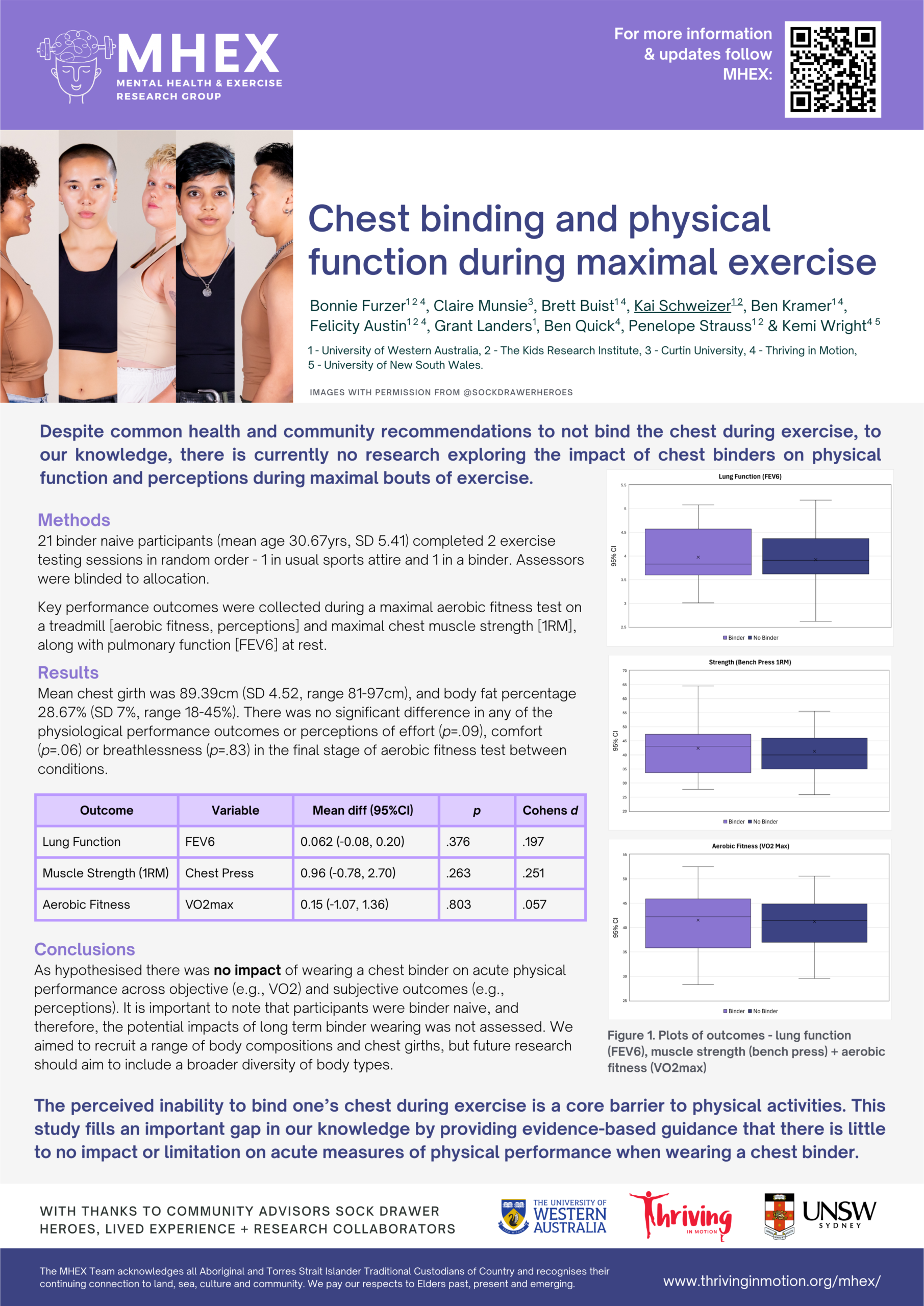
Chest Binding Research Poster from Auspath 2025 conference

What is chest binding?

Chest binding is the practice of using a compression garment to flatten the chest, often to create a more masculine appearance. It is commonly practised by trans and gender diverse people, with studies reporting that up to 87% of trans and gender diverse people presumed female at birth have bound their chest at some point (Lee et al., 2019).

Binding can help to reduce gender dysphoria, depression, and anxiety, and can improve self-esteem and quality of life (Julian et al., 2021; Sood et al., 2021; van den Brink et al., 2020).

Why did we study chest binding and exercise?

Trans community guidance has often advised against exercising in a binder due to safety concerns. For people who experience chest dysphoria, this advice can be a real barrier to physical activity. If exercising without a binder feels too dysphoric, a person may avoid exercise altogether or choose to bind regardless of the guidance. In one study of trans and gender diverse teens, 84% reported that they had exercised in a binder.

Until recently, there was no research to assess whether exercising in a binder is actually unsafe. We at MHEX decided to find out.

How the study was conducted

We recruited 21 adults presumed female at birth who had never worn a binder before. Each participant completed two exercise sessions: one wearing a binder, and one in their regular sports clothes. All participants received a professional binder fitting to ensure they were wearing the correct size.

We measured four key outcomes:

  • Lung function
  • Upper body strength
  • Cardiovascular fitness (including maximal oxygen uptake during intense exercise)
  • Comfort during exercise

What we found: no significant differences

We found no significant difference in any of the measured outcomes between wearing a binder and not wearing a binder. You can download our preliminary results here: AusPATH 2025 Furzer

What this means for people who bind

Our findings suggest that the commonly held belief that exercising in a chest binder is always unsafe is not necessarily supported by the evidence. In the short term, wearing a binder does not appear to impact lung function, strength, fitness, or comfort during exercise.

This matters because trans and gender diverse people face many barriers to physical activity, and chest binding has historically been one of them. We hope this research helps to reduce those barriers and supports greater participation in movement, exercise, and sport.

Limitations of the study

This study is an important first step, but it does not prove there are no risks associated with binding during exercise. A few things to keep in mind:

  • We did not measure temperature response or skin irritation, so we cannot speak to how exercising in a binder might affect these.
  • The study focused on short-term outcomes, so we cannot draw conclusions about the effects of binding regularly over a long period.
  • All participants were fitted with the correct binder size. Results may differ for people binding with an incorrectly fitted binder.

A complementary study published last year helps address some of these gaps. Voss et al. (2025) conducted similar testing with trans and gender diverse teens who had been binding regularly. Their findings were consistent with ours, showing that wearing a binder did not significantly change exercise capacity measures.

Conclusion: what the current evidence tells us

Chest binding is an important practice for alleviating gender dysphoria and supporting the quality of life of trans and gender diverse people. The available research, including our MHEX study, suggests that binding during exercise does not significantly impact exercise capacity. However, the evidence base is still developing, and further research is needed.

Full results of our study will be available later in 2026!

MHEX continues to investigate exercise and health for trans and gender diverse communities as part of our broader research programme at the University of Western Australia and University of New South Wales. If you would like to stay up to date with our work, get in touch or subscribe via the MHEX website.


WITH THANKS TO COMMUNITY ADVISORS SOCK DRAWER HEROES, LIVED EXPERIENCE + RESEARCH COLLABORATORS

References:

Furzer, B., Munsie, C., Buist, B., Schweizer, K., Kramer, B., Austin, F., Landers, G., Quick, B., Strauss, P., Wright, K. (2025). Chest binding and physical function during maximal exercise. AusPATH Conference 2025, Nipaluna (Hobart), Tasmania. Access the poster here: AusPATH 2025 Furzer et al

Julian, J. M., Salvetti, B., Held, J. I., Murray, P. M., Lara-Rojas, L., & Olson-Kennedy, J. (2021). The impact of chest binding in transgender and gender diverse youth and young adults. Journal of Adolescent Health, 68(6), 1129–1134. https://doi.org/10.1016/j.jadohealth.2020.09.029

Lee, A., Simpson, P., & Haire, B. (2019). The binding practices of transgender and gender-diverse adults in Sydney, Australia. Culture, Health & Sexuality, 21(9), 969–984. https://doi.org/10.1080/13691058.2018.1529335

Sood, R., Chen, D., Muldoon, A. L., Chen, L., Kwasny, M. J., Simons, L. K., Gangopadhyay, N., Corcoran, J. F., & Jordan, S. W. (2021). Association of chest dysphoria with anxiety and depression in transmasculine and nonbinary adolescents seeking gender-affirming care. Journal of Adolescent Health, 68(6), 1135–1141. https://doi.org/10.1016/j.jadohealth.2021.02.024

van den Brink, F., Vollmann, M., & van Weelie, S. (2020). Relationships between transgender congruence, gender identity rumination, and self-esteem in transgender and gender-nonconforming individuals. Psychology of Sexual Orientation and Gender Diversity, 7(2), 230–235. https://doi.org/10.1037/sgd0000357

Voss, R. V., Carl, R., Kuhns, L. M., Liem, R. I., Rybacki, D., Wolf, S., & Garofalo, R. (2025). The impact of chest binding on exercise capacity in transgender and gender diverse adolescents. Journal of Adolescent Health, 77(6), 1175–1180. https://doi.org/10.1016/j.jadohealth.2025.08.024
Questions?

Get in touch with the MHEX Team – mhex@uwa.edu.au

The MHEX Team acknowledges all Aboriginal and Torres Strait Islander Traditional Custodians of Country and recognises their continuing connection to land, sea, culture and community. We pay our respects to Elders past, and present.

We are committed to embracing diversity and eliminating all forms of discrimination through education and inclusive communities. We welcome all people and are respectful of individual identities.